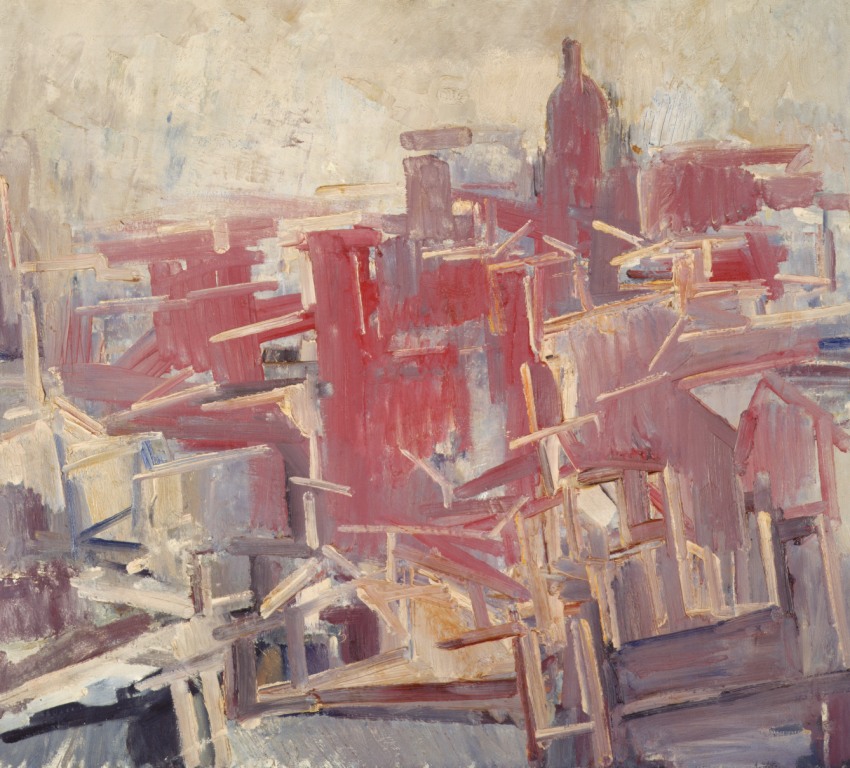
Leeds
Creffield, Dennis
1965, Oil on canvas, 91 x 101

Cozens, Alexander
An 18th century artist who created landscapes from ‘blots’ of ink and his imagination. An English artist, born in Russia, the son and grandson of English shipbuilders employed by Peter the Great, Alexander Cozens lived in Archangel and St. Petersburg before being sent to school in London at the age of ten. He returned to Russia but in 1746 he went to Rome where he spent three years studying drawing and painting. In 1749, he returned to England and took up a position as drawing master at Christ’s Hospital, Berkshire, followed by teaching drawing at Eton College. At Eton College, Cozens began experimenting in painting in watercolour without a preliminary pencil or ink outline, using ‘blots’ to create landscape. These blots formed the basis of a system he set out in his treatise, A New Method of Assisting the Invention in Drawing Original Compositions in Landscape. To ‘blot’, he wrote, ‘ is to make varied spots and shapes with ink on paper, producing actual forms, without lines, from which ideas are presented to the mind’. His idea was to invent nature rather than to imitate it in his work. Alexander Cozens was the first English artist to work entirely as a landscape painter. His watercolour, Landscape, Two Hills and Cultivated Fields, was given to the LACF by Sir Michael Sadler in 1922.
Creffield, Dennis
1965, Oil on canvas, 91 x 101
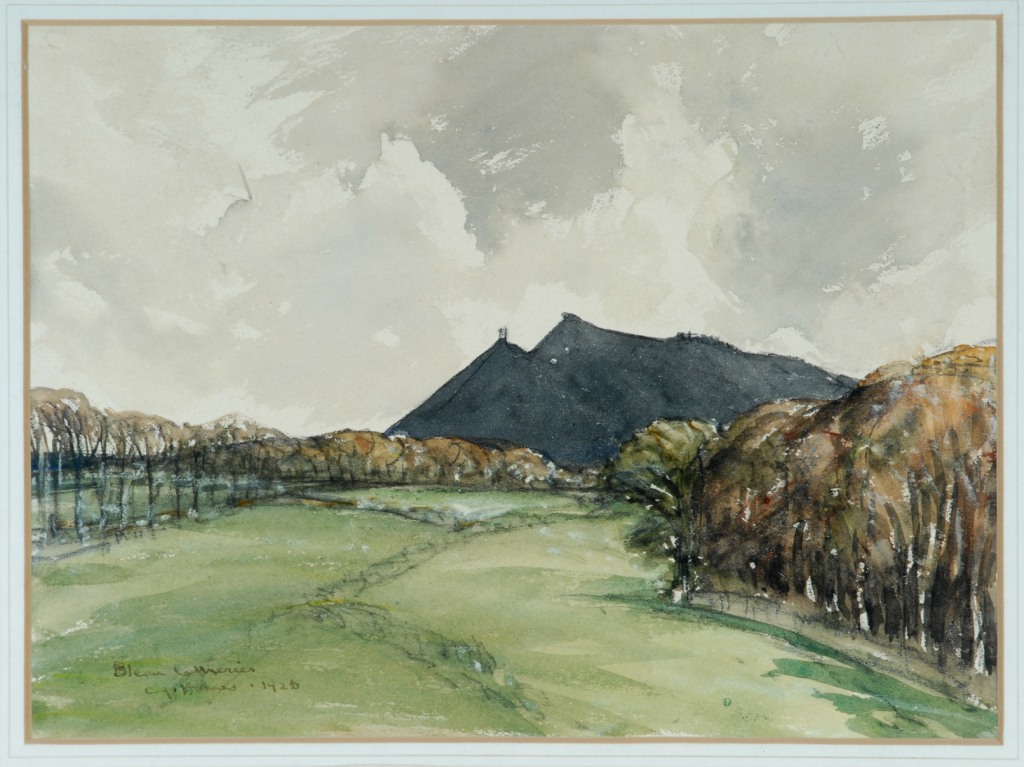
Holmes, Sir Charles J.
Drawing with watercolour, 25.8 x 34.4

Anon
1710