The Collections supported by Leeds Art Fund

Leeds Art Fund has contributed to 430 acquisitions and owns outright a collection of some 200 works some of which have been given by our members. It is a diverse and dynamic assortment of artworks including paintings, sculpture, and works of applied art including silver, furniture and ceramics. You can explore a selection of some of the items we have helped to purchase on this page.

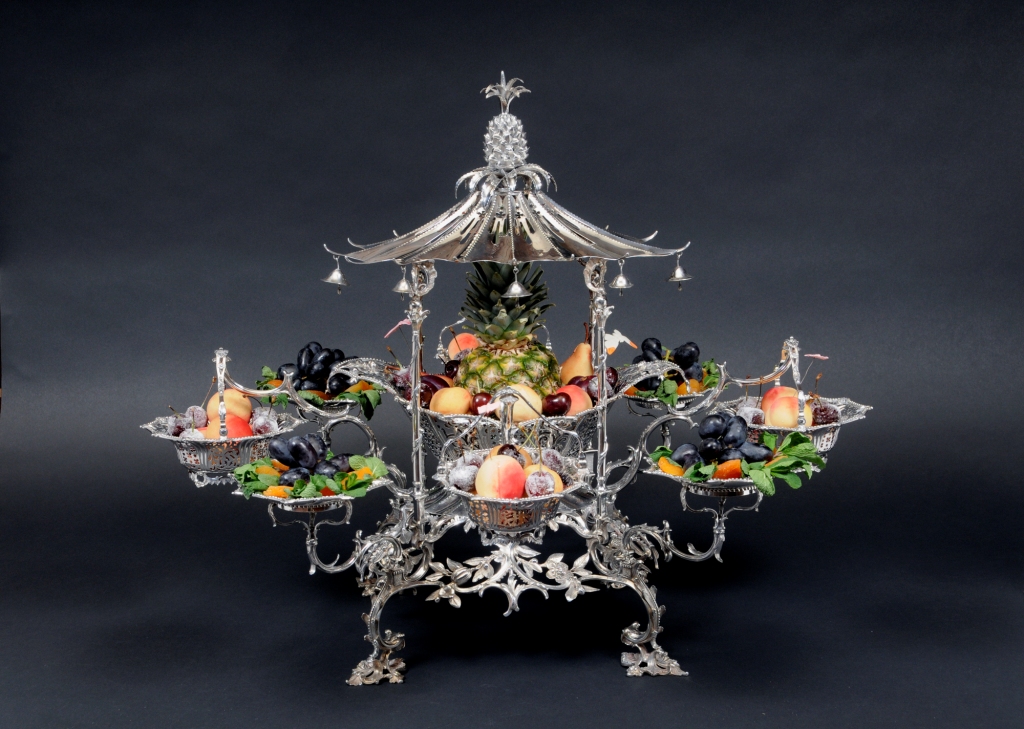
Silver Chinoiserie Epergne

Artists

Cassolet

Cassolet

Boulton, Mathew

1775, Birmingham

H. 31

A tripod perfume burner of a type used to sweeten the air in the dining rooms of great 18th century houses.

Made from white marble and ormolu (gilt bronze), the cassolet, (from the French word for ‘perfume burner’) is in the form of a covered marble vase raised on an ormolu tripod bolted to a triangular marble plinth. The perforated cover is surmounted by a fruit-finial.

The design corresponds to a drawing in Boulton and Fothergill’s Pattern Book I, p.171 but probably originated from a plate in James Athenian Stuart and Nicholas Revett’s Antiquities of Athens, the first volume of which was published in London in 1762. More information about this cassolet can be found in N.P. Goodison’s, Matthew Boulton: Ormolu (2002), Shena Mason (ed), Matthew Boulton: Selling what the world desires (2009), and  Christopher Gilbert’s Furniture at Temple Newsam  House and Lotherton Hall, (1978).

Globe Inkstand

Boulton, Matthew (Attrib.)

H. 40

Globe inkstands of this design became fashionable during the last quarter of the eighteenth century.

The hollow spherical body is constructed in two halves, the divided upper section being formed of pivoted segments which open to reveal a circular tray with stands for a set of three blue glass ink and pounce jars and penholders.

The globe is mounted in an upright circular frame consisting of two rings supported by four carved stays ornamented with lions’ masks suspending floral festoons. The outspreading scroll legs terminate in hairy claw and ball feet.

At the apex is a winged Victory figure operating the pressure catch which opens the globe. The inkstand rests on a galleried plinth fronted by a shallow drawer with statuettes representing ‘Africa’, ‘Asia’ and ‘Europe’.

The sides are faced with blue glass panels contained within laurel borders and the sycamore base is set on fronded bracket feet. The inkstand was given anonymously through the LACF in 1969. (Gilbert, C., Furniture at Temple Newsam House and Lotherton Hall

No products in the basket.