The Collections supported by Leeds Art Fund

Leeds Art Fund has contributed to 430 acquisitions and owns outright a collection of some 200 works some of which have been given by our members. It is a diverse and dynamic assortment of artworks including paintings, sculpture, and works of applied art including silver, furniture and ceramics. You can explore a selection of some of the items we have helped to purchase on this page.

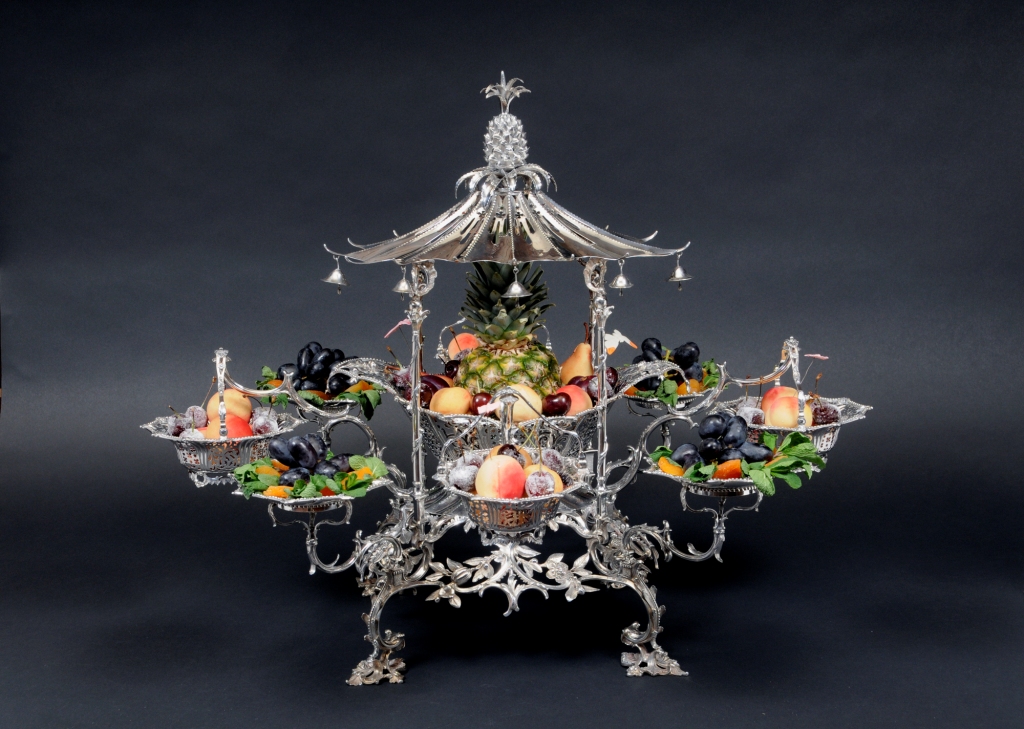
Silver Chinoiserie Epergne

Artists

Industrial Landscape

Industrial Landscape

Kramer, Jacob

1914

Leeds Art Fund was delighted to help with the recent purchase of this important Kramer drawing.

Though Leeds Art Gallery already has a strong collection of Jacob Kramer works this new acquisition is a significant addition – both to the collection and to the knowledge of Kramer’s personal history, as he so rarely made landscapes.

Drawn in 1914, this bleak view of a northern town seems to signify the industrial power needed to equip modern warfare whilst at the same time foreseeing the waste of life the war would bring.

This drawing begins to place Kramer within the landscape tradition, something that his practice had not previously been associated with.
Ruhula

Kramer, Jacob

c. 1917, Oil on canvas, 91.5 x 71

An important Leeds-based artist, in whose honour Leeds Branch College was renamed. Born in the Ukraine to Jewish parents who came to England in 1900, Jacob Kramer attended the Leeds School of Art and studied at the Slade School in London in 1912. In March 1915, Kramer accepted an invitation to exhibit as an independent artist at the first (and only) Vorticist exhibition. He was not a member of the Vorticist group, although he applied their semi-abstract style to Jewish subjects. Kramer became a significant figure in Leeds, painting portraits of many local businessmen and professional people. He became president of the Leeds Fine Art Club in1959. After his death, Leeds Branch College, where Kramer had taught, was renamed as Jacob Kramer College.  Ruhala, c. 1917,was bought with the aid of a bequest through LACF in 1999.Two other paintings were  also bought in 1999. The Talmudists, c. 1919, was bought with the help of an anonymous donation through LACF and Rite of Spring, 1920, a painting inspired by Stravinski’s ballet music, was also bought by the LACF in that year.

The Talmudists

Kramer, Jacob

1919, Oil on canvas, 63.5 x 76.2

An important Leeds-based artist, in whose honour Leeds Branch College was renamed Jacob Kramer College. Born in the Ukraine to Jewish parents who came to England in 1900, Jacob Kramer attended the Leeds School of Art and studied at the Slade School in London in 1912. In March 1915, Kramer accepted an invitation to exhibit as an independent artist at the first (and only) Vorticist exhibition. He was not a member of the Vorticist group, although he applied their semi-abstract style to Jewish subjects. Kramer became a significant figure in Leeds, painting portraits of many local businessmen and professional people. He became president of the Leeds Fine Art Club in1959. After his death, Leeds Branch College, where Kramer had taught, was renamed as Jacob Kramer College. The Talmudists, c. 1919, was bought with the help of an anonymous donation through the LACF in 1999.

Rite of Spring

Kramer, Jacob

1920, Oil on canvas, 63.4 x 76

An important Leeds-based artist, in whose honour Leeds Branch College was renamed Jacob Kramer College. Born in the Ukraine to Jewish parents who came to England in 1900, Jacob Kramer attended the Leeds School of Art and studied at the Slade School in London in 1912. In March 1915, Kramer accepted an invitation to exhibit as an independent artist at the first (and only) Vorticist exhibition. He was not a member of the Vorticist group, although he applied their semi-abstract style to Jewish subjects. Kramer became a significant figure in Leeds, painting portraits of many local businessmen and professional people. He became president of the Leeds Fine Art Club in1959. After his death, Leeds Branch College, where Kramer had taught, was renamed as Jacob Kramer College.

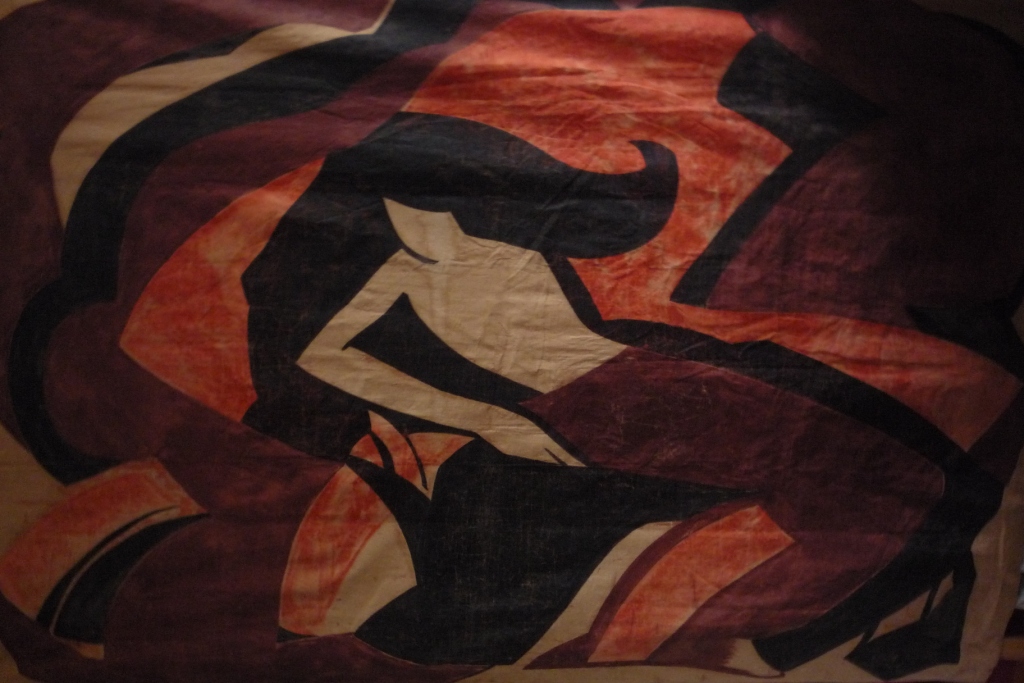
Untitled Textile Hanging

Untitled Textile Hanging

Kramer, Jacob

textile hanging (canvas), 2370 cm x 1630 cm

This large, abstracted and unstructured (unstretched) canvas is quite possibly unique in Jacob Kramer’s output. The canvas seems to hover between the figurative and the abstract.  It may have been commissioned by Edward Standish and perhaps formed part of a decorative scheme for his London house.  It has echoes of the Omega Workshop, of which Kramer would have been aware although he was not directly associated with it.  The received view of Jacob Kramer is of a provincial Jewish <span style=”font-family: Arial, Helvetica, sans-serif;”>émigré ‘expressionist’ figurative painter, but his interest in and contribution to abstraction was significant. He wrote for Wyndham Lewis’ Blast, corresponded with Herbert Read and came under the influence of Kandinsky.  In this vein his Abstract Composition, c. 1917, The Rite of Spring, c. 1920 and an unexecuted design for Mining for Leeds Town Hall are all in Leeds Art Gallery’s collection, together with some seventy other works.  Jacob Kramer is in many ways Leeds’ ‘Modernist’ artist, formed by the thinking of Alfred Orage’s Leeds Art Club and the contemporary of artists such as Bomberg, Gertler, Meninsky, Nevinson and William Roberts. The hanging was bought in 2014 with the aid of grants from the LAF and   from  the Leeds Art Fund Patrons through Deborah Davis.

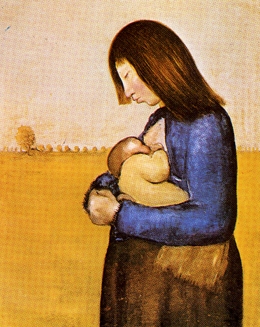
Mother and Child 1915

Mother and Child 1915

Kramer, Jacob

1915, Oil on canvas, 89 x 70 cm

Bequeathed by Dr William and Mrs Elizabeth Whitaker 2014. Bequeathed to the Leeds Art Fund in 2014 this painting is traditionally recognised as Kramer’s first major work and he described it as ‘one of my best and biggest pictures’. First displayed in 1915 at the New English Art Club Winter Exhibition it caused some controversy. Lucien Pissarro commented that ‘the picture of a mother openly breastfeeding her infant lacked taste’. The donor was Kramer’s doctor for a time and apparently he often paid his bills with his paintings. This example was bought as a wedding present for the donor’s wife in 1960.

No products in the basket.