The Collections supported by Leeds Art Fund

Leeds Art Fund has contributed to 430 acquisitions and owns outright a collection of some 200 works some of which have been given by our members. It is a diverse and dynamic assortment of artworks including paintings, sculpture, and works of applied art including silver, furniture and ceramics. You can explore a selection of some of the items we have helped to purchase on this page.

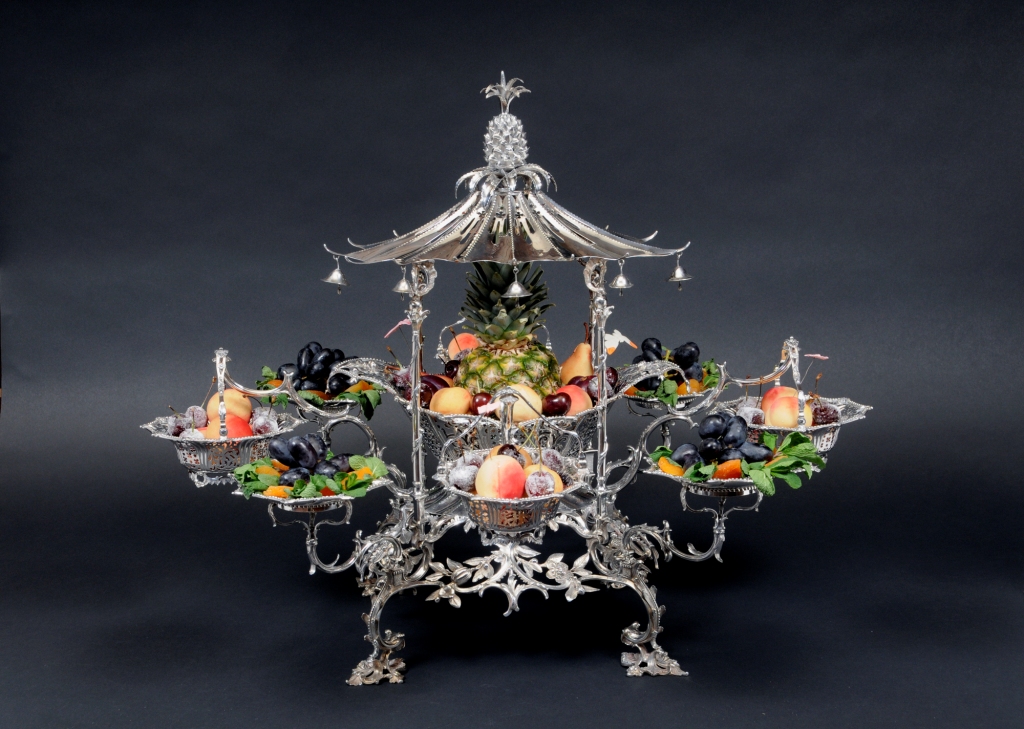
Silver Chinoiserie Epergne

Artists

The Artist in her Studio

The Artist in her Studio

Rego, Dame Paula

1993, Painting; acrylic on canvas, 180 x 130

An artist whose work sometimes refers to her memories of the scary folk tales told to her by her grandmother in Portugal. A British painter and printmaker of Portuguese birth, Paula Rego was born in Lisbon. Her father was posted to England and Rego was left in the care of her grandmother until she was four years old. In Portugal she attended a school where the pupils were taught in English. Later she came to a finishing school in England and then won a place at the Slade School of Art, London, where she studied from 1952-56.  In 1962-3 Rego received a bursary from the Calouste Gulbenkian Foundation headquarters in Lisbon. She married a British artist, Victor Willing and in 1976 she settled permanently in London with her husband. Her work often refers to memories of the folk tales told to her by her grandmother and is also associated with feminism. Rego’s first major solo exhibition was in Lisbon but in 1988 her work was shown at the Serpentine Gallery, London and began to be bought by collectors and institutions. In 1990 Rego was appointed the First National Gallery Associate Artist (artist in residence). In 2009 a new museum dedicated to Rego’s work was opened in Cascais, Portugal and in 2010 she was created a Dame of the British Empire. The Artist in her Studio was bought with the aid of a contribution from the LACF in 1994.

Après le Bain

Après le Bain

Renoir, Pierre Auguste

Pastel drawing, 65.5 x 52.9

A painter who was perhaps the most well known of the French Impressionists. Pierre-Auguste Renoir was born in Limoges, where his father was a tailor and his mother a seamstress. The family moved to Paris when Renoir was five years old. In 1854, at the age of thirteen, Renoir was apprenticed to a porcelain painter in Paris, where he gained experience of painting in the fresh, light colours that he would later apply to his own paintings. In 1861 Renoir entered the studio of Charles Gleyre in Paris, where he met other artists including Monet and Sisley, with whom he painted near the village of Barbizon, on the outskirts of the Forest of Fontainebleau. In 1870 Renoir was drafted into the French army to serve in the war against Germany. However, he became seriously ill and did not see active service. After the war, Renoir returned to Paris and in 1874 he helped to organize and took part in the first exhibition by the artists who came to be known as the Impressionists. This first exhibition was not successful but Renoir was supported by wealthy patrons and their friends, a number of whom commissioned portraits from him. From the 1880, Renoir painted many pictures of young women and girls as a celebration of female beauty These paintings were very popular and Renoir became wealthy. In 1907 he bought a piece of land at Cagnes on the French Riviera. On it he grew olives, vines and oranges and then had a house and studio built on his property. He lived there for the rest of his life but suffered increasingly from rheumatism, which affected his fingers and made painting difficult. Après le Bain was bought by the LACF in 1945.

Bureau – Plat (Writing Table)

Bureau – Plat (Writing Table)

Risenburgh, Bernard II van

1745

H. 81; L. 211

A writing table made in Paris for the owner of Allerton Park, Yorkshire.

Made in Paris  for Richard Arundale of Allerton Park,Yorkshire , this table formed part of the furnishings either at  Allerton Park or at Arundale’s London house.  To design his Yorkshire house, Arundale commissioned John Vardy (1718-1765,) a celebrated eighteenth century architect.

 An elegant pen and wash drawing by Vardy shows that this writing table was originally surmounted by an imposing cartonnier with a clock, ormolu candlebranches and a sloping desk.  Both this and the table are recorded in an inventory made in 1774, but the cartonnier has since disappeared. 

 The table is veneered in kingwood and its rectangular top is lined with tooled red leather, rimmed by a moulded brass border. The frieze contains five drawers; the long central one is recessed and is flanked by a pair of narrow drawers concealed behind the shaped wings of the drawer fronts at either side. The tapering cabriole legs bear rich knee mounts of elaborately scrolled rococo design. 

Bernard van Risenburgh, the maker of this table, had become a tre-ebéniste by 1730 and the earliest precisely datable  bureau-plat  made by him was for the French  Dauphin at Versailles in 1745. It is thought that the most satisfactory provisional date for this piece is c. 1745. 

The table was bought with the aid of a contribution from the LACF in 1972. (Gilbert, C., Furniture at Temple Newsam House and Lotherton Hall, Vol. II, 1978) (Vardy’s drawing is now held in the Drawing Collection of the Royal Institute of British Architects.)

The Age of Bronze

The Age of Bronze

Rodin, Auguste

1877 (this cast 1907), Bronze, 178 x 60 x 610

A French sculptor who, after a slow start, became world-famous. Born in Paris, Auguste Rodin’s nearsightedness made him unable to see what his teachers were writing on the blackboard, so, instead, he drew during lessons. He made three applications to study at the École des Beaux Arts in Paris but all were rejected and Rodin worked as a decorative bricklayer for almost twenty years. Then he visited Italy, from where he returned inspired to create sculpture. The Age of Bronze, originally called The Vanquished, was his first piece. The nude man is clenching both his fists, with his right hand hanging over his head. It depicts suffering but also hope for the future. It was made in 1877 and first exhibited in 1878. This cast dates from 1907. The cast was bought with the aid of a contribution from the LACF in 1994.

Lord Raby’s Silver Wine Cistern

Lord Raby’s Silver Wine Cistern

Rollos, Philip

Lord Raby’s silver wine cistern


One of the largest pieces of silver ever made in England this magnificent cistern or wine cooler was bought for Temple Newsam after an Export Licence Deferral in 2011.

The massive cistern or wine cooler, weighing almost 2,600 ounces, was supplied to Thomas Wentworth, Lord Raby (later Earl of Strafford) when he was appointed ambassador to Berlin in 1705. All ambassadors were entitled to take with them silver objects weighing up to 5,893 oz of white silver and 1,066 of gilt in order that they could entertain in an appropriate style in the name of their sovereign. On return home they were generally allowed to retain this ‘official’ silver, emblazoned ith the royal arms, as recompense for their services. Massive silver wine cisterns or coolers were the most impressive and often the most sculptural objects made by goldsmiths for dining rooms in the baroque period (c1660 – c1730). They were filled with packed ice for keeping bottles cool and frequently formed an ‘eyecatcher’ on the sideboard together with other ceremonial and useful pieces. After being used at Berlin (where it would have rivalled the King of Prussia’s magnificent silver) Lord Raby’s cistern would have joined the rest of his accumulated silver at his seat at Wentworth Castle, near Barnsley (designed by the purssian court architect Jan de Bodt).      

Bad Hat

Bad Hat

Rothschild, Eva

Sculpture: Perspex, 239 x 163 x 142

Described on the website of the Tate Gallery as “one of the most interesting artists of her generation”. Born in Dublin, Ireland, Rothschild studied first at the University of Ulster, Belfast (1990-1993) and at Goldsmiths College, London (1998-1999). She works in materials that include, Perspex, Plexiglas, leather and paper and she also makes videos. Her work was exhibited at the Tate Triennial, New British Artists in 2006 and has been shown in Europe, Australia and America. The floor-based sculpture Bad Hat was bought with the aid of a contribution from the LACF in 2002.

Head of a Man

Rouault, Georges

1926, Aquatint, 577 x 43.7

A French painter whose pictures of the outcasts of society the public found disquieting. A French painter and graphic artist, who had already completed his apprenticeship in a stained- glass workshop before entering the École des Beaux Arts in 1891. His paintings, with strong outlines and vivid colours reflected his work as designer of stained glass. Rouault was a prolific painter, producing paintings of the outcasts of society which expressed his hatred of cruelty and vice but which were disturbing to the public. Rouault was also the illustrator of numerous books. The acquatint Head of a Man, dated 1926, was bought by the LACF in 1948. It was executed as one of the illustrations for two books that were to be written. The project was begun in 1916 but was never completed. For this work, Rouault used a special process, first making a study in gouache which was then transferred photographically to a copper plate which was then worked the artist using acquatint, drypoint and direct biting with acid. [Leeds Art Calendar, Summer 1948, p.2]

Rugg, Matt

1962, Relief in wood

A carver and sculptor highly regarded by his contemporaries and students. Born in Bridgwater, Somerset, Rugg studied in the Department of Fine Art, King’s College, University of Newcastle upon Tyne. He originally studied painting but moved to take up carving, relief work and sculpture. Rugg exhibited his work widely during the 1960s and in 1965 he moved to London to teach in the sculpture department at Chelsea College of Art. Two of his reliefs in wood, Unit Relief, dated 1962 and Sign Elements III, dated 1963, were bought by the LACF in 1963.

Lamia No. 2

Lamia No. 2

Sargent, Francis William

c. 1910, Sculpture: bronze, 31

A British sculptor who worked for many years in Italy. Born in Hampstead, London, the son of a barrister, Sargant studied at the Slade School of Art, London and later in Florence and Munich. For most of his career he lived in Florence, where he had a studio and where he worked largely in the medium of marble. He exhibited his work in London, Paris and Munich. Lamia was given anonymously through the LACF in 1958.

Old Man’s Head

Old Man’s Head

Sichel, Ernest Leopold

Drawing, coloured chalks, 23.3 x 20

Born in Bradford, Ernest Sichel was a contemporary of William Rothenstein, another Bradford artist. A Bradford-born Jewish artist, the son of a manufacturer from Frankfurt am Main, Sichel studied at the Slade School of Art. He was an artist, sculptor and modeller. From 1891, Sichel exhibited his work at the Royal Academy and the New English Art Club. At some time between 1885 and 1890 he returned to Bradford, where he lived and worked until his death in 1941. Old Man’s Head, in coloured chalks, was bought by the LACF in 1924.

Juliet and the Nurse

Juliet and the Nurse

Sickert, Walter Richard

1935 – 6

During the 1930s Sickert, who had always been attracted to the theatre, frequently attended performances, made friends with the actors and made paintings on their subjects.

The paintings were usually derived from press photographs and Edith Evans – here as the nurse – features in at least one other painting, and Peggy Ashcroft – here as Juliet – in several others. 

The technique of painting from photographs (or other graphic sources such as prints) was widely used by Sickert in the 1930s – it encouraged a tonal (as opposed to linear) vision and Sickert used – or had his assistants use – a dry ‘scraped’ brushwork, showing often bare canvas between paint areas, with a concentration on large masses curiously flattened – unparalleled before Andy Warhol.  

Raku Vase

Raku Vase

Smith, Martin

1978

30 x 29

A vase decorated with a striking geometric design by one of Britain’s foremost ceramic artists.

Born in Essex, Martin Smith studied at the Ipswich School of Art, the Bristol Polytechnic Faculty of Art and the Royal College of Art.  After teaching at Loughborough College of Art and Design and Camberwell College, Smith joined the staff of the Royal College of Art in 1989 and was appointed Professor of Ceramics and Glass in 1999. 

Martin Smith is one of Britain’s most highly regarded ceramic artists and was one of the first to consider pottery pieces as primarily aesthetic forms divorced from function as vases, jugs, etc.  This early work, decorated with incised geometric sgrafitto,  marks the beginning of his longstanding interest in architecture. 

The use of contrast in this piece is typical of Smith who frequently juxtaposes different materials and colours in his work.

Christ’s Entry into Jerusalem

Christ’s Entry into Jerusalem

Spencer, Stanley

1920

One of the first in a series of large religious paintings by Spencer bought by the Leeds Art Collections Fund in 1941.

The scene is set in the High Street at Cookham, Spencer’s home village to which he had returned following war service with the Royal Army Medical Corps.

Although the setting of a religious scene in a contemporary context may seem unconventional, it does in fact have a tradition stretching back to the Middle Ages.

This is one of a series of large scale religious paintings which Spencer began in 1920, the same year in which he was invited to submit designs for murals for Leeds Town Hall, a project which never came to fruition.

Spencer’s is the personal vision of an artist whose beliefs were unorthodox and often disconcerting.

Christ’s Entry Into Jerusalem

Christ’s Entry Into Jerusalem

Spencer, Stanley

Oil on canvas, 114.2 x 144.8

An artist perhaps best known for his biblical scenes, set in the village where he lived and worked for most of his life. An English artist, Stanley Spencer was born in Cookham, Berkshire. His father was a music teacher and Stanley was the eighth child in a family where religion, music and literature were of the greatest importance. Spencer studied at the Slade School of Art from 1908-12 and won prizes. His work was exhibited at the Second Post-Impressionist Exhibition in 1912. At the beginning of the First World War, Spencer enlisted, serving first in the Royal Army Medical Corps at a hospital in Bristol and later in Macedonia. His experiences of wartime service were movingly expressed in his art ten years afterwards when he painted murals for the Sandham Memorial Chapel at Burghclere, commissioned by the parents of a soldier who, like Spencer, had served in Macedonia. During the Second World War , Spencer again served as an official war artist, this time in Glasgow, where he painted large canvases showing the work of shipbuilders on the Clyde. Stanley Spencer was created a CBE in 1950 and was knighted a few months before his death in 1959. Religion played an important part in Spencer’s life, as did the village of Cookham, where he was born and lived for many years. He is said to have thought of Cookham as ‘a village in heaven’. Christ’s Entry into Jerusalem is shown taking place in a street in Cookham. The painting was bought by the LACF in 1941. The Leeds Art Fund has also bought three other works by Stanley Spencer: Madonna Lilies, Cookham, oil on panel, (bought 1936); Gardens in the Pound, Cookham, oil on canvas (bought 1940) and Study for Leeds Decoration, watercolour (bought 1973).

The Music of the Wind

The Music of the Wind

Stirling Lee, Thomas

c. 1907, Sculpture in wax, 66 x 25 x 23.5

A sculptor who specialized in reliefs and portrait medallions. Thomas Stirling Lee was born in Lambeth, London, the son of a surveyor. He was educated at Westminster School and after serving as an apprentice in the studio of John Birnie Philip, studied at the Royal Academy Schools (1876-80) where he was awarded a gold medal and a travelling scholarship to study in Paris. Stirling Lee specialized in making reliefs and portrait medallions. He made bas-reliefs for Leeds Town Hall and was a member of the National Portrait Society from 1910-15. The Music of the Wind, a sculpture in wax, is the model for the silver statuette in the Sam Wilson bequest, given to the LACF by Sam Wilson in 1913.

Large Plate

Large Plate

Taylor, Sutton

D47.5

A work which shows the taste for rich colour and abstract design of this Yorkshire-born potter.

Sutton Taylor is one of Britain’s leading potters and his work is exceptionally well represented in the Leeds collection. He is a Yorkshireman, born in Keighley.  He trained as a teacher and worked in Manchester before moving to Jamaica and travelling in America. .  In 1970 he returned to England and  for a time lived in the stable block at Temple Newsam House.

He then moved to the Old House at Lotherton Hall where a ceramic nameplate still bears witness to his presence. There he had his kiln and wrestled with the extraordinary technical problems of firing lustreware – while managing not to burn the house down!

This magnificent charger shows his taste for working with rich colour and abstract design, sometimes fluid, sometimes geometrical and often with a mixture of both. It makes a telling comparison with the Victorian lustreware of William de Morgan (1839-1917) with its symmetry and use of figurative design – see the Charger painted to a design by William de Morgan of c. 1885, also at Lotherton Hall.

The Gladiators

Thornton, Leslie

Sculpture, bronze, copper, brass; 79.5 x 55.5 x 48.5

A British sculptor, born in Skipton, Yorkshire, Leslie Thornton first studied at Keighley Art School from 1940-42. In 1943 he was conscripted to work in the coalmines but from 1945-48 he studied at Leeds School of Art and from 1948-51 at the RCA Sculpture School. In 1955 Thornton’s work was included in the New Sculptures Exhibition at the ICA in London and later that year he participated in the Young British Sculptors exhibition organized by the British Council. In 2004 Thornton’s work was included in the exhibition 100 Years of Sculpture at the Henry Moore Institute in Leeds. The Gladiators was bought by the LACF c. 1958.

Red Circle

Red Circle

Thubron, Harry

c. 1964, Relief sculpture in wood, 68.5 x 71 x 21

Christened Henry James Thubron, Harry Thubron was born in Bishop Auckland, County Durham. He studied at Sunderland School of Art (1933-8) and at the Royal College of Art (1938-40). He served in the Armed Forces from 1941-46. In the early part of his career as an artist Thubron produced figurative works but later changed to creating reliefs in resin, metal and wood. Thubron taught at Leeds College of Art from 1955-64 and at Goldsmiths School of Art from early in1970. A major exhibition of his work was held at the Serpentine Gallery, London in 1976. In 2007 a number of his works were shown in a one-man exhibition at Austin/Desmond Fine Art. All were acquired by Damien Hirst, who had been a student of Thubron’s at Goldsmiths in the early 1980s. Red Circle was bought by the LACF in 1964. Another work by Thubron, Uomo, an Assemblage, was bought with the aid of a contribution from the LACF in 1985.

Series No. 2

Series No. 2

Tucker, William

1968, Sculpture; fibre glass, 83 x 228 x 210

Two cylindrical pieces, provide the viewer with a complicated pattern of angles and intersections. Born in Cairo to British parents who returned to England in 1937, William Tucker is a modernist sculptor and modern art scholar. He read Modern History at Oxford University, whilst also attending the Ruskin School of Drawing. He then studied sculpture at Saint Martin’s School of Art, London, where Anthony Caro was one of his teachers. From 1968-1970, Tucker was Gregory Fellow in Sculpture at the University of Leeds. Series No. 2 is one of a series of four variations on the theme of interlocking cylinders that he made in 1968. Series A No. 2 is composed of two H-shaped cylindrical pieces, one laid above the other and turned at an angle to it. The arrangement provides the viewer with a complicated pattern of angles and intersections, where the arms of the H-shapes are not parallel and are not of the same length. It was bought by the LACF in 1969. In 1972, Tucker was Britain’s representative at the Venice Biennale. He moved to New York in 1978 and became an American citizen in 1985. He has received a number of awards, winning the Royal Academy Summer Exhibition Sculpture Prize in 2009 and was a recipient of the International Sculpture Center’s Lifetime Achievement in Contemporary Sculpture Award in 2010.

Valley of the Washburn

Valley of the Washburn

Turner, J.M.W

1818

Watercolour with bodycolour on buff paper

This scene was painted by Turner during one of his many visits to Farnley Hall, near Otley, in Yorkshire, the seat of Walter Hawksworth Fawkes, a wealthy landowner who began collecting Turner’s work in 1803 and became one of the artist’s greatest patrons.

One of many views of the landscape of the Lower Wharfe Valley painted by Turner for Walter Fawkes of Farnley Hall. 

It shows the view to the south from the Washburn Valley, looking towards Caley Park, with Wharfedale in the distance. 

Caley Park was at that time part of the Farnley Hall, estate where Turner was a regular visitor between 1808 and 1824.  These were social visits;  Turner greatly enjoyed the country pursuits of shooting and fishing and was regarded almost as a member of the Fawkes family.  

In April 1919, Walter Fawkes opened the rooms of his house in Grosvenor Place, London to the public.  Turner’s watercolors constituted by far the greatest part of the exhibition. 

Fawkes dedicated the exhibition catalogue to Turner, writing that he did so as ‘an Offering of Friendship’. Turner never returned to Farnley Hall after the death of his patron and great friend Walter Fawkes. 

The picture was bought with the aid of a contribution from the LACF in 1997.   

Pair of Console Tables and Pier Glasses
OLYMPUS DIGITAL CAMERA

Pair of Console Tables and Pier Glasses

Vile, William and Cobb, John

H. 244, W. 137; Tables, H. 89, W. 152

The Royal cabinet-makers, William Vile and John Cobb, Long Acre, London, invoiced this pair of console tables and pier glasses to the Earl of Coventry on 6th December, 1761.

Made from pine,  painted white and gilt, this pair of console tables and mirror plates was commissioned by the Earl of Coventry for the saloon at Croome Court, Worcestershire.  The mirror plates are set  in oval frames, H. 244, W. 137.  The  console tables have Breccia Corallina marble tops resting on cabriole legs, H. 89, W. 152.  They were bought with the aid of a contribution from the LACF in 1974.

Billingsgate – Fishing Boats

Whistler, James Abbott McNeill

c. 1859, Etching, 15.1 x 22.5

An American-born artist who came to Europe and was one of the most cosmopolitan artist of the nineteenth century. Whistler was born in Lowell, Massachusetts. His father, Major George Washington Whistler, had studied civil engineering at the US Military Academy at West Point.   Since America was at peace during Whistler’s early childhood, Major Whistler became a successful railway engineer. In 1842 Czar Nicholas I invited him to design the first railway in Russia and the family moved to St. Petersburg. James was educated at the czar’s court, where he learned to speak French and took drawing at the Imperial Academy of Fine Arts. His father died in 1849 and his mother moved back to America with her two sons. Because of her late husband’s connections, Mrs. Whistler gained a place for her son James at West Point in 1851. Whistler achieved only low grades at West Point and was discharged, after which he joined the U.S. Coast and Geodesic Survey in Washington D.C. but resigned after three months. In 1855, Whistler left America for Paris, where he lived and worked with other painters, including Fantin-Latour, until he settled London in 1859, although still he made regular visits to Paris. It was in that year that Whistler began a series of sixteen etchings known as the ‘Thames Set’, of which ‘Billingsgate – Fishing Boats’ is one. In the mid nineteenth-century, Billingsgate was the main covered fish market in Britain and fishing boats would enter this small inlet on the Thames to deliver their catch. This etching was bought by the LACF in 1917.  Another work by Whistler, Old Battersea Bridge, dated 1879, is also illustrated  here.

Old Battersea Bridge

Old Battersea Bridge

Whistler, James Abbott McNeill

1879, Lithograph, 20.8 x 34.4

An American-born artist who came to Europe and was one of the most cosmopolitan artists of the nineteenth century. Whistler was born in Lowell, Massachusetts. His father, Major George Washington Whistler, had studied civil engineering at the US Military Academy at West Point. Since America was at peace during Whistler’s early childhood, Major Whistler became a successful railway engineer. In 1842 Czar Nicholas I invited him to design the first railway in Russia and the family moved to St. Petersburg. James was educated at the czar’s court, where he learned to speak French and took drawing at the Imperial Academy of Fine Arts. His father died in 1849 and his mother moved back to America with her two sons. Because of her late husband’s connections, Mrs. Whistler gained a place for her son James at West Point in 1851. Whistler achieved only low grades at West Point and was discharged, after which he joined the U.S. Coast and Geodesic Survey in Washington D.C. but resigned after three months. In 1855, Whistler left America for Paris, where he lived and worked with other painters, including Fantin Latour.  He moved to London in 1859 but continued to make regular visits to Paris. Whistler was a dandy, a wit and a lavish host, whose lifestyle led him to be almost permanently in debt. He was awarded many honours during his career, perhaps the most prestigious of which was that of his appointment as an officer of the French Legion of Honour, after his most famous work, Arrangement in Grey and Black: Portrait of the Painter’s Mother, was purchased by the French state. The entry for James Abbot McNeill Whistler in the Dictionary of National Biography states that ‘Few painters have exercised a deeper or wider influence over their contemporaries than Whistler.’  The lithograph, Old Battersea Bridge, was donated to the Leeds Art Fund by R.H. Kitson in 1920.

Temper (1991-92)

Temper (1991-92)

Wilding, Alison

1991-92, Sculpture, Perspex, steel, brass and rubber

A sculpture which may relate to a basic element of our psychology. A British sculptor, born in Blackburn, Lancashire, Alison Wilding grew up in St. Ives, Huntingdon. From 1967-70 she studied at Ravensbourne College of Art and Design, Bromley, Kent and from 1970-73 at the Royal College of Art. After leaving the RCA, Wilding incorporated numerous materials into her work, including beeswax, transparent plastics, textiles and a variety of pigments, enabling her to set up contrasts of form and colour. In the summer of 1991 she exhibited ten years’ work at the Tate Gallery Liverpool and five new works at the Henry Moore Sculpture Trust at Dean Clough in Halifax. She chose one of the new works to show at the Turner Prize exhibition in 1992. Her work was short-listed but she did not win the Prize. Temper (1991-92) was made at the time when Wilding’s work was becoming well-known and was bought with the aid of a contribution from the LACF in 1996.

The Doppelganger

Willats, Stephen

1984, Photographic print, mixed media, 2 panels each 136 x 98

An English conceptual artist and sculptor for whom the making of art is a social practice. Stephen Willats was born in London and studied at Ealing School of Art in 1962-3. During the 1960s Willats became a pioneer of conceptual art. His multi-media works often involve creative social projects.  For Willats, the making of art is a social practice, concerned with the effects the structure of modern urban society has on the individual. The Doppelganger, in which a City worker is by night transformed into a skinhead, is one of a series of works made by Willats in 1984, exploring the night-time world of alternative cultures. This work was bought with the aid of a contribution from the LACF in 1988.

Small Stone Bridge

Small Stone Bridge

Williams, Glynn

1988, Sculpture: Hopton Wood Stone, 45.7 x 15.2 x 11.4

A sculptor of the Figurative tradition. Born in Shrewsbury, Glynn Williams attended Wolverhampton College of Art from 1955-61. On graduation, Williams was awarded the British Prix de Rome Scholarship. From 1961-63 he lived and worked in the British School in Rome.  Since 1967 Williams’ work has been widely exhibited, both in one-person and group exhibitions  He taught at the Royal College of Art, becoming Head of Sculpture in 1990 and Head of the School of Fine Art from 1995-2010. Williams’ public works include memorials to David Lloyd George in Parliament Square and Henry Purcell in Westminster, London. Small Stone Bridge was given anonymously to the LACF in 1988.

Dress, designed by Charles Frederick Worth

Dress, designed by Charles Frederick Worth

Worth, Charles Frederick

1881

An English-born textile salesman who became a world-famous Paris fashion designer.

Charles Frederick Worth was born in Bourne, Lincolnshire and worked first as an apprentice and clerk for two textile merchants in London. Having acquired an expert knowledge of fabrics through his work, he moved to Paris in 1845 to join a French textile company.

Whilst working as one of their leading salesmen, he opened a small dressmaking department within the company and in 1858 set up his own firm. His designs were known for his use of luxurious fabrics and Worth’s name came to dominate the Parisian fashion scene in the latter part of the nineteenth century. This dress was made for Mary Holden Illingworth of Bradford (1838-1908), who wore it to her daughter’s wedding in 1881.

Mary came from a wealthy Yorkshire mill owning family. Her father, Isaac Holden, was a self-made man who made a fortune in the weaving industry, with mills in both Bradford and Paris. His daughter Mary was interested in fashion and this was not her first dress from Worth.

She later recounted how ‘fittings were of dubious delight, as Monsieur Worth was of the habit of taking a cup of warm fresh blood straight from the local abatoir at 11a.m.’  The dress was bought with the aid of a contribution from the LACF in 2011.

No products in the basket.